
Categories
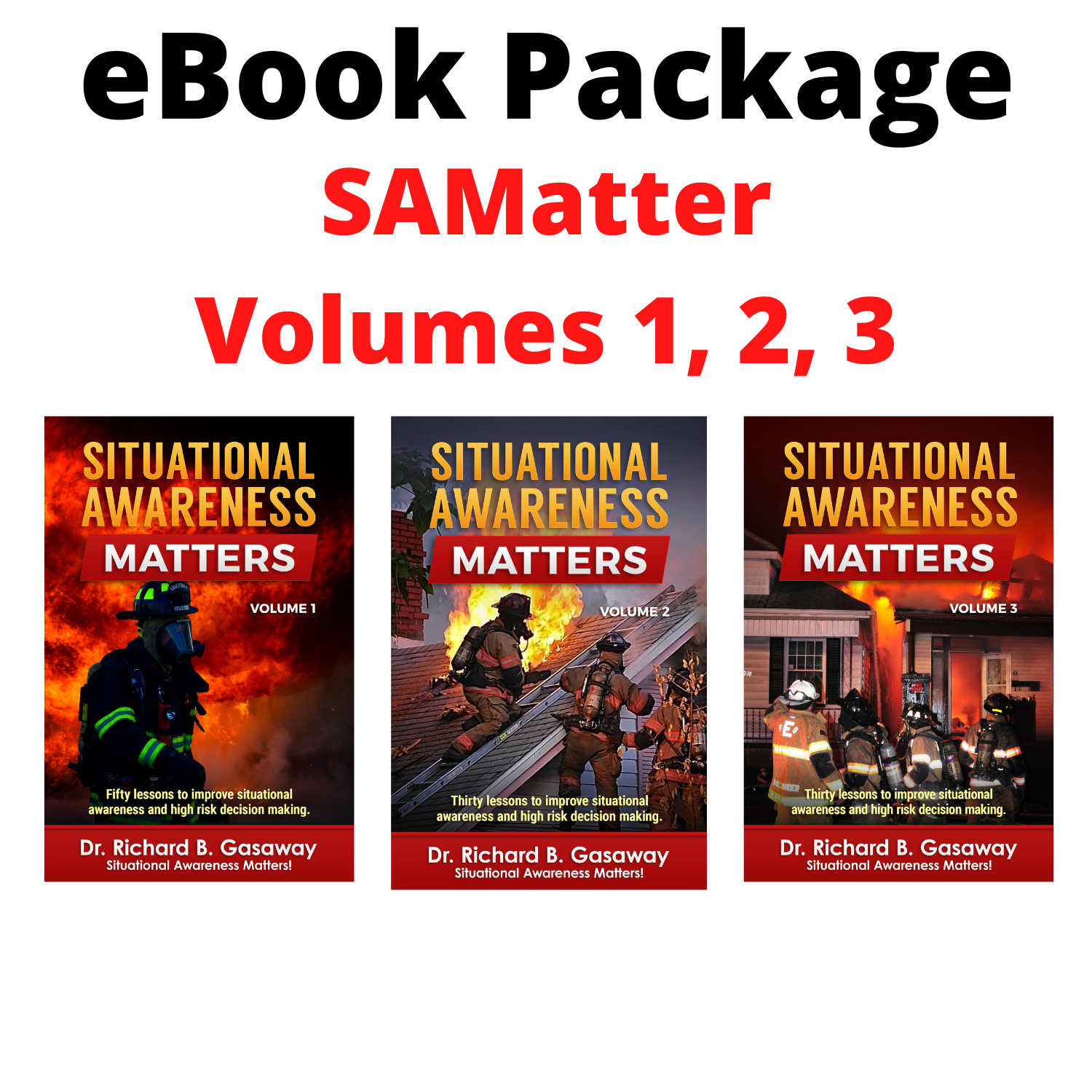
SAMatters Volumes 1, 2, 3 eBook Series
$50.00
1
SAMatters Volumes 1, 2, 3 eBook Series
Product Details
These eBooks are a collection of articles from the Situational Awareness Matters! website. Situational Awareness Matters is completely dedicated to the mission of helping first responders see the bad things coming in time to change the outcome.
To say that situational awareness is important for first responders would be a gross understatement. It is the leading cause of near miss events and the leading contributing factor for casualty events. The motivation for this work comes my passion to improve the safety of the dedicated men and women serving on the line protecting their communities every day. I am truly humbled to play a small part in helping to protect the protectors.
I have dedicated the past fifteen years of my life to the study of the art and science of decision making and to learn as much as I possibly can about situational awareness in the high-risk, high-consequence decision making environments of first responders, aviation, medicine, military, nuclear energy and others. Many of these lessons are rooted on cognitive psychology and other fields of neuroscience.
While my doctoral work and extensive research are the foundation of my contributions to these books, I am also a firefighter. I go to great lengths to avoid using complex scientific terms or phenomenon. The lessons contained here are too important to risk your misunderstanding.
How to use these eBooks
The chapters in these eBooks are dedicated to improving your situational awareness. Many of the chapters feature discussion questions that can be used during classroom sessions, hands-on training evolutions or coffee table discussions. The greatest value will come when you share the knowledge you acquire from these books with others.
Situational Awareness Matters Volume 1
267 pages in .pdf format
Topics
- Independent actions (freelancing)
- Staffing levels impact situational awareness
- Fatigue impacts situational awareness
- How to cancel the mayday
- Equipment orientation builds situational awareness
- Radio communications is essential to situational awareness
- Shared (team) situational awareness
- The rational brain and situational awareness
- Situational awareness is more important than paying attention
- Standard operating procedures can harm situational awareness
- Performance expectations are important to situational awareness
- Multitasking impacts situational awareness
- A walking PAR can improve situational awareness
- Expect the unexpected to improve situational awareness
- Meta awareness and situational awareness
- The impact of distractions and interruptions on situational awareness
- When budgets impact staffing, tactics must change
- We must stop the insanity (Parts 1-4)
- Two keys to improve learning and recall
- Ten things to develop situational readiness
- The facilitated debrief: A lesson from aviation
- Defensive decision making
- Crawl, walk, run theory of skill development
- The role of emotions in decision making
- Leadership means leading
- Complacency: A killer of first responders
- Safety trumps self-esteem in good decision making
- Penalties and discipline will not improve safety
- Situational awareness of your weakest link
- Stop judging to improve situational awareness
- Completing the 360-degree size-up
- Four size-up priorities
- The "minor" mayday
- The five step assertive statement process
- Risk versus reward
- Context dependent learning
- It's just a car fire
- What are you going to do to ensure my spouse comes home after every call?
- Ten explanations for unsafe actions
- Will denial make the problem better or worse
- Are you assuming risk or creating risk
- A recipe from hell's kitchen (Parts 1-5)
- You can't handle the truth
Situational Awareness Matters Volume 2
272 pages in .pdf format
Topics
Physical, chemical and emotional impact of stress
Types of stress
Some stress is good
Communications overload impacts situational awareness
Hyper vigilance
Tunnel vision
Auditory exclusion
Information overload
Time distortion
Creatures of habit
Commanders in turnout gear?
Mobile data computers and situational awareness
Peer pressure can impact situational awareness
Situational awareness starts with the size up
When the puzzle pieces don't fit
Every building on fire is in the process of falling down
Noise impacts situational awareness
Five situational awareness lesson from a LODD
Dangerous mindsets: The starter
Dangerous mindsets: The subordinate
Dangerous mindsets: The specialist
Dangerous mindsets: The superior
Dangerous mindsets: The stubborn
Dangerous mindsets: The silent
Dangerous mindsets: Superman/Superwoman
Dangerous mindsets: The slacker
Dangerous mindsets: The synergist
Independent action can impact situational awareness
Tracking of personnel
Staffing for the mayday/rapid intervention
Situational Awareness Matters Volume 3
272 pages in .pdf format
Topics
The physical, chemical and emotional impact of stress
Types of stress
Some stress is good
Communications overload impacts situational awareness
Hyper vigilance
Tunnel vision
Auditory exclusion
Information overload
Time distortion
Creatures of habit
Commanders in turnout gear?
Mobile data computers and situational awareness
Peer pressure can impact situational awareness
Situational awareness starts with the size-up
When the puzzle pieces don’t fit
Every building on fire is in the process of falling down
Noise impacts situational awareness
Five situational awareness lessons from a LODD
Nine dangerous mindsets: The starter
Nine dangerous mindsets: The subordinate
Nine dangerous mindsets: The specialist
Nine dangerous mindsets: The superior
Nine dangerous mindsets: The stubborn
Nine dangerous mindsets: The silent
Nine dangerous mindsets: Super Man/Woman
Nine dangerous mindsets: The slacker
Nine dangerous mindsets: The synergist
Independent action can impact situational awareness
Tracking of personnel
Staffing for the mayday/rapid intervention
About the author
Richard B. Gasaway, PhD, CSP is widely considered a trusted authority on human factors, situational awareness and the high-risk decision making processes used in high-stress, high consequence work environments. He served 33 years on the front lines as a firefighter, EMT-Paramedic, company officer, training officer, fire chief and emergency incident commander. His doctoral research included the study of cognitive neuroscience to understand how human factors flaw situational awareness and impact high-risk decision making.
